Rose Hips: A Guide to their Medicinal Use, Harvest, Preparation & Recipes
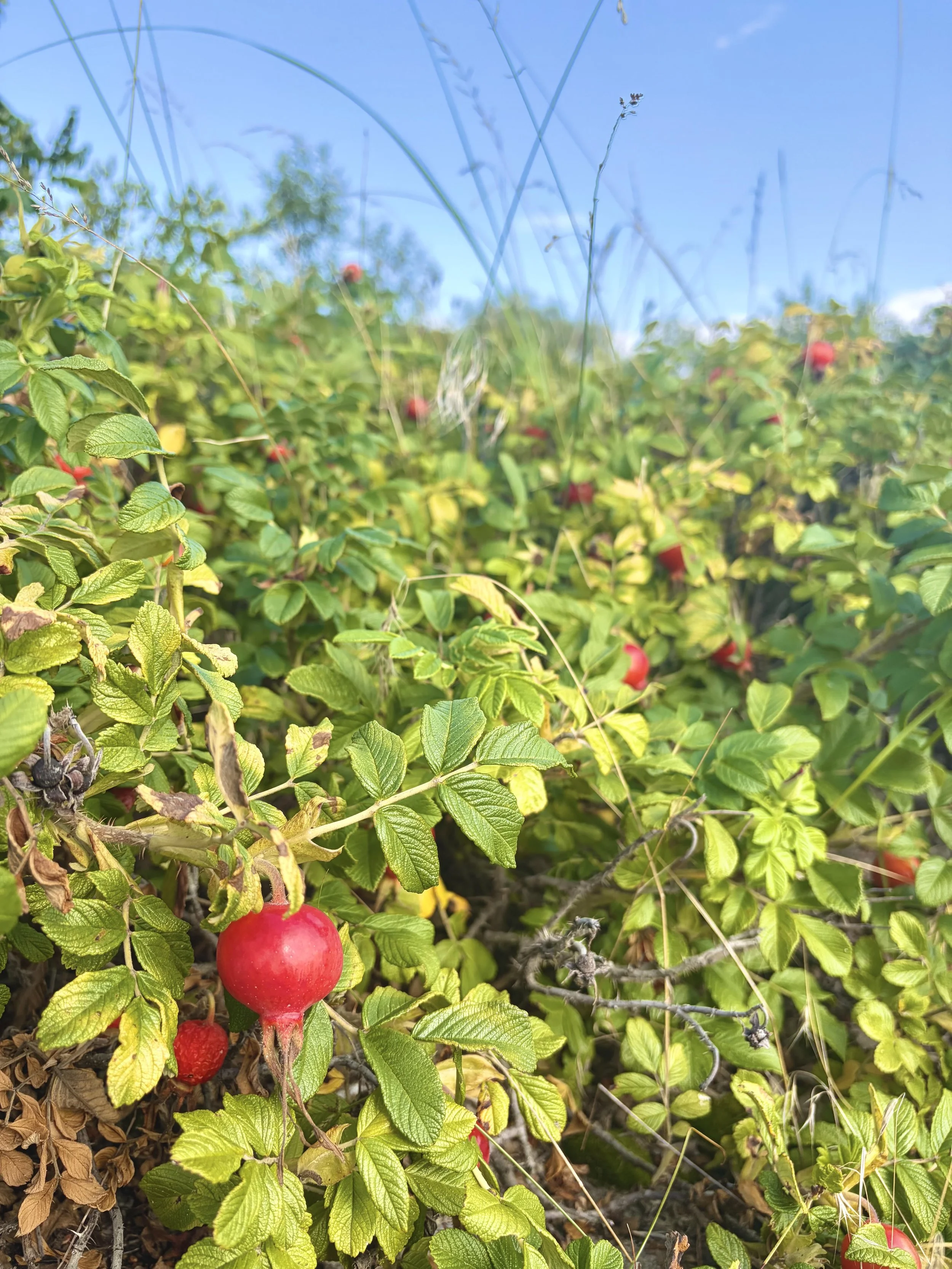
Beach Rose (Rosa rugosa)
I had the pleasure of spending heaps of time at the ocean this summer. It's truly my medicine. One of my favorite plants to spend time with there is the abundant Beach Rose (Rosa rugosa), whose Rose Hips are perfectly ripe and ready to harvest right now. Later, in the early fall, the Rose Hips of our common inland Wild Rose (Rosa multiflora) will ripen, brightening the landscape with their red glow in the hedgerows.
Both make great medicine, although the hips of the Beach Rose are undeniably larger, tastier and juicer. Read on below for in-depth info on the medicinal use of Rose Hips and ways to incorporate them into your apothecary and kitchen.
Rose Hip (Rosa spp)
Materia Medica
Species: Any Rosa genus species can be used. They all produce edible and medicinal fruits. Common northeast and southeast species are Rosa multiflora and Rosa rugosa (Beach Rose). Worldwide there are around 100 Rosa species which are widely spread across North America, South America, Asia, the SWANA region, and Europe.
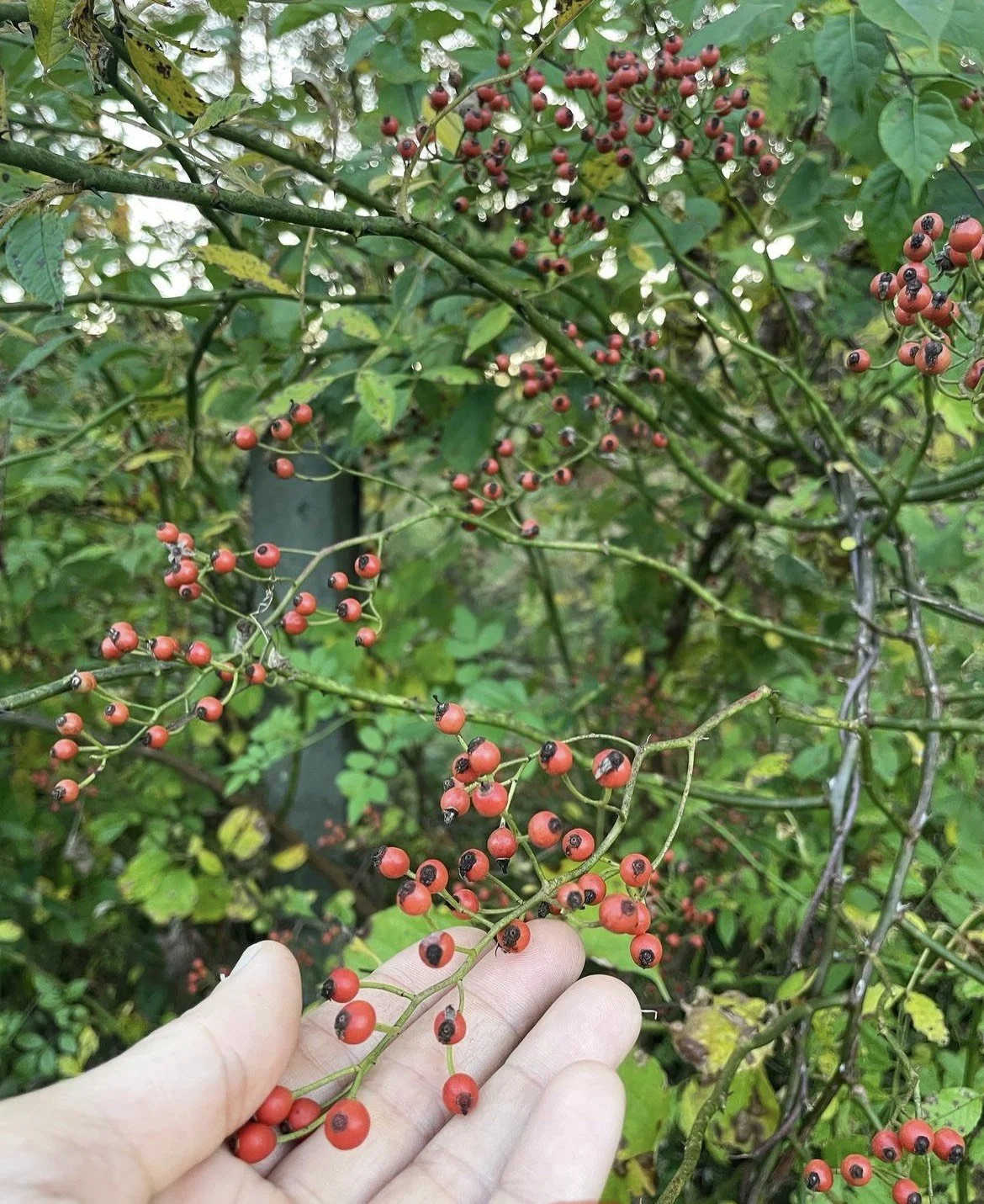
Wild Rose (Rosa multiflora)
Identification:
Rose Hips are the fruits that grow on Rose bushes after the flowers have been pollinated. Rosa multiflora (aka Wild Rose or Multiflora Rose) loves to grow in old fields, along forest edges, in over-grown areas, and on farms and is a medium-sized, climbing, thorned shrub that can form a thicket. They're very abundant in the northeast, southeast, and parts of the Midwest and are very sustainable to forage as they’re introduced from Asia and considered “invasive.” Look for the hips growing in clusters on the branch tips of leggy shrubs that have thorns that curve downwards. Often the leaves have already fallen by the time they are ripe, but if they haven’t yet, look for compound leaves with opposite leaflet pairs with 5 to 9 leaflets per compound leaf, with feathered stipules and the leaf stem base. You might confuse them with Barberry (Berberis spp) berries, which are also edible, but Barberry has more needle-like thorns and Roses have the characteristic curved thorns of a Rose. Also remember that they grow on clusters at the tips of the branches, whereas Barberry berries hang from the underside of their branches.
Rosa rugosa aka Beach Rose is found throughout coastal regions of the northeast, southeast, and parts of the pacific northwest and is easily identifiable by its large, round, red hips found growing on thorny shrubs. This medium-sized shrub does not climb, but does create thick thickets. The dead branches are heavily thorned and the living branches also have thorns. Unlike R. multiflora, the thorns of R. rugosa are more needle-like, rather than curved. The leaves are more robust with a leathery look to them and wrinkled. They are also pinnately compound with leaf pairs, each 3-6” in length, with fine, gray hairs on the underside.
And any Rosa species hips can be worked with, even garden roses. A nice sour flavor indicates the presence of vitamin C! The hips come along after the flower is long gone and are the fertilized ovary of the Rose flower. They ripen to bright red (and occasionally purple in a few species) in the fall and vary in shape from round to oval and range in size from just 6 mm to over 3 cm in diameter. Regardless of the size they all have a sweetish-sour outer pulp which surrounds numerous hairy seeds and another helpful identifying tip is to look for vestiges of the sepals and stamen at the tip of the Hip, which is especially obvious on the hips of the Beach Rose.
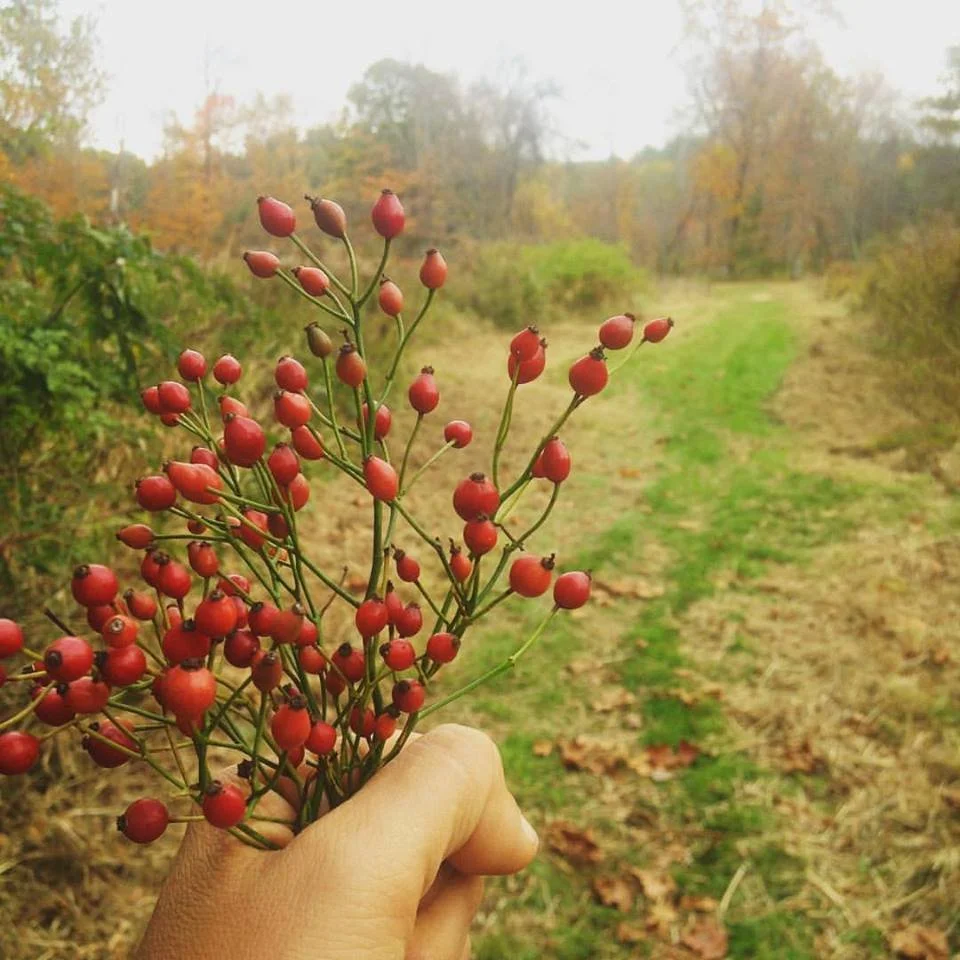
Gathering Rosa multiflora hips
Collection: Rosa rugosa ripens in late summer whereas Rosa multiflora ripens in early fall and the hips of each should be harvested when they are bright red. The hips will be the sweetest after a frost however, in some regions, such as the southeast and parts of the northeast, they begin rotting by the fall and are best harvested when they are freshly ripe in late summer. Additionally, some research indicates that the nutritional content starts to decline after the frost. Baseline is to be sure they are nice and colorful before harvesting. I harvest the Hips of R. multiflora in whole clusters and dry on the stem (called a corymb) and throw the whole thing into broths, syrups, and decoctions. I harvest the Beach Rose hips individually
Part Used: Whole, uncrushed Hips or hulled Hips
When consuming Rose Hips it’s important to know that the seeds are encased in hairs which are irritating to the gut and can cause diarrhea. Most Rose Hips sold commercially are hulled, meaning they have the seeds and hairs removed. Hulled Rose Hips can be used the same way you would any dried fruit in foods and beyond.
If you are harvesting your own Rose Hips whole there are a few ways to contend with the hairs. One way is to cut them in half and remove the seeds and hairs individually, which is very time-consuming and doesn’t make sense with the small hips of Rosa multiflora. Another way to safely use them is to work with them whole. As long as you don’t crush the hips and release the hairs, you will be fine and this a traditional way to work with Rose Hips. This is how I choose to work with Rosa multiflora hips.
NOTE: Some folks suggest simmering the hips whole and mashing them for jam and then removing the seeds and hairs with a food processor….I’ve heard too many first-hand horror stories of the digestive upset that goes along with this method to recommend it or try it myself, but you will find some folks recommending this. If you choose to do this my advice would be to strain it multiple times.
Herbal actions: Antioxidant, Anticancer, Astringent, Anti-inflammatory, Immune tonic, Nutritive
Constituents:
Fruits- Bioflavinoids (including carotenoids, which give them their red color), Vit C (generally about 50% more than oranges), Vit A, Vit B1, Vit B2, Vit B3, Niacin, Vit K, Vit E, Polyphenols (including quercetin and ellagic acid), Pectin, Calcium, Phosphorous, Iron, Copper, Magnesium. Nutritional content varies by region and species! Research shows vitamin C is more concentrated in fresh than dried fruits
Seeds- Contain many unsaturated lipids; generally between 40-56% lineolic acid, α-linoleic and its derivatives between 20–30%, and oleic acid 14–20%. Also varies based on species and region
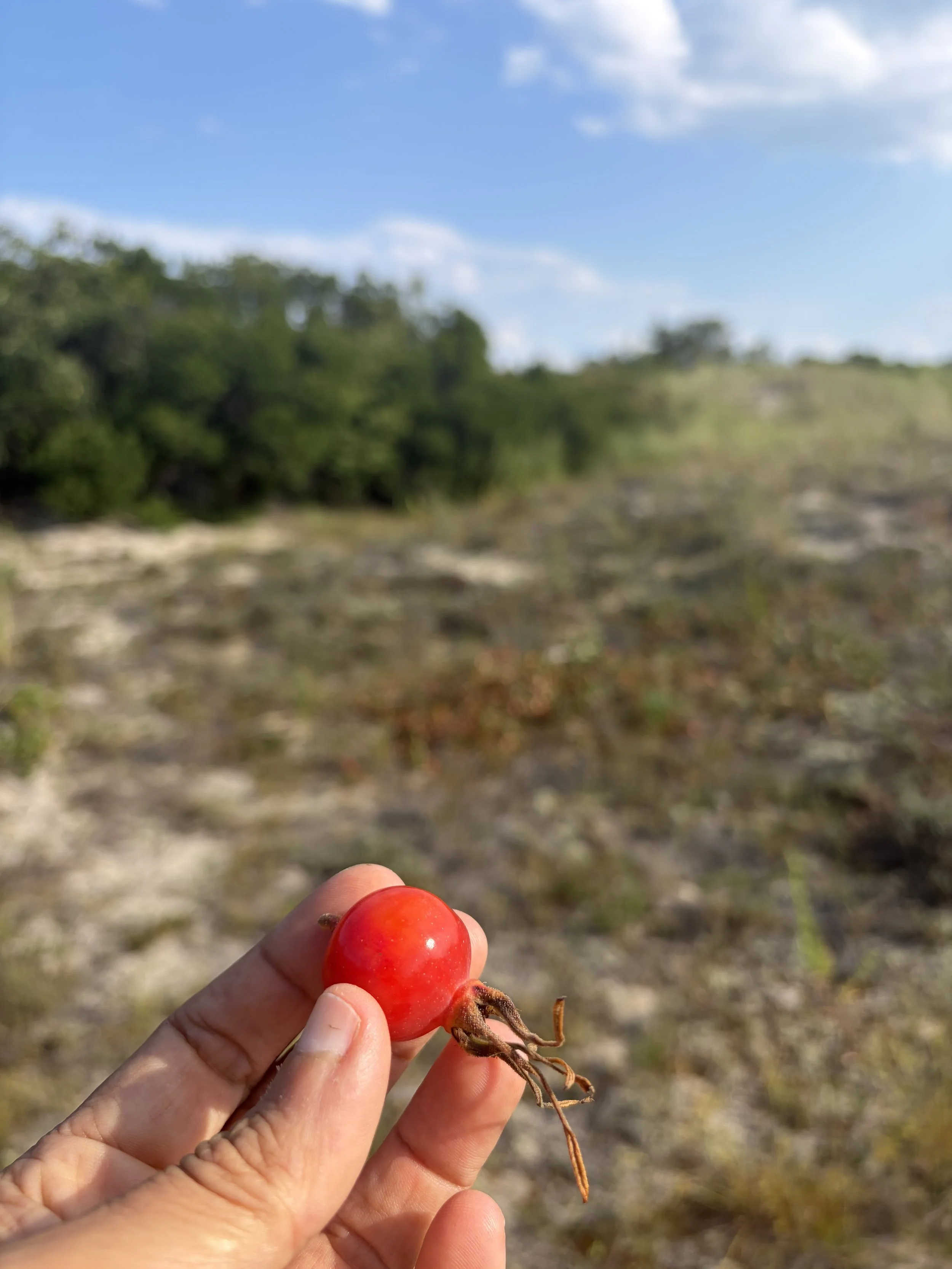
Beach Rose Hip (Rosa rugosa)
Medicinal use:
Fruits-Nutritive, rich in numerous vitamins and minerals, helpful for weakness and fatigue. Rose Hip's primary claim to fame is their high Vitamin C content, and I use them all winter long in winter immunity teas when my immune system is feeling a little low and are excellent for colds, flus and low immunity. It's true that Vitamin C is degraded somewhat by heat, but they're so rich in it that there will still be plenty available in a tea. Vitamin C is also fantastic for tissue health and integrity- specifically skin, tendons, ligaments, and blood vessels. Adequate levels of Vitamin C also ensure proper wound healing and scar tissue repair, and helps the body maintain healthy teeth, cartilage, and bones too! Rich in bioflavonoids (antioxidants), which are support cardiovascular health. Strongly antioxidant, helping fight free radicals (also known as Reactive Oxygen Species/ROS), which are very pro-inflammatory. Their antioxidant activity is attributed primarily to their polyphenols, vitamins C, E, B and carotenoids and these compounds may have synergistic effects! Many of the antioxidants found in Rose Hips are anticancer and have been shown to initiate apoptosis (cell death) in cancer cells. These same antioxidants are anti-inflammatory and research has shown potential for reducing the pain and inflammation associated with osteoarthritis and rheumatoid arthritis. Sometimes used in menopause to allay symptoms of dropping estrogen, such as hot flashes, as vitamin C increases bioavailability of estrogen in the body. Traditional uses around the world abound, including treating colds, flu, coughs, mucous congestion, fevers, arthritis and rheumatoid arthritis, and both bacterial and viral infections.
Excellent food as medicine. See below for ideas on working with Rose Hips in your food!
Seeds- Rose Hip Seed Oil is widely used in the cosmetics industry for skin health and is strongly antioxidant
Herbal preparations:
Decoction (simmer for 20-30 min to optimally extract)- 1 heaping tsp dried or 1 heaping tbsp fresh: cup H20.
Nourishing Infusion- 1 tbsp dried Rose Hips: 1 cup just-boiled H20. Steep at least 4 hrs up to overnight. Strain. Drink 2-4 cups/day
Also wonderful in an Oxymel, Vinegar, Elixir/Cordials, Electuary or Powder (make sure they’re hulled!) or Syrup
Rose Hips in the Kitchen
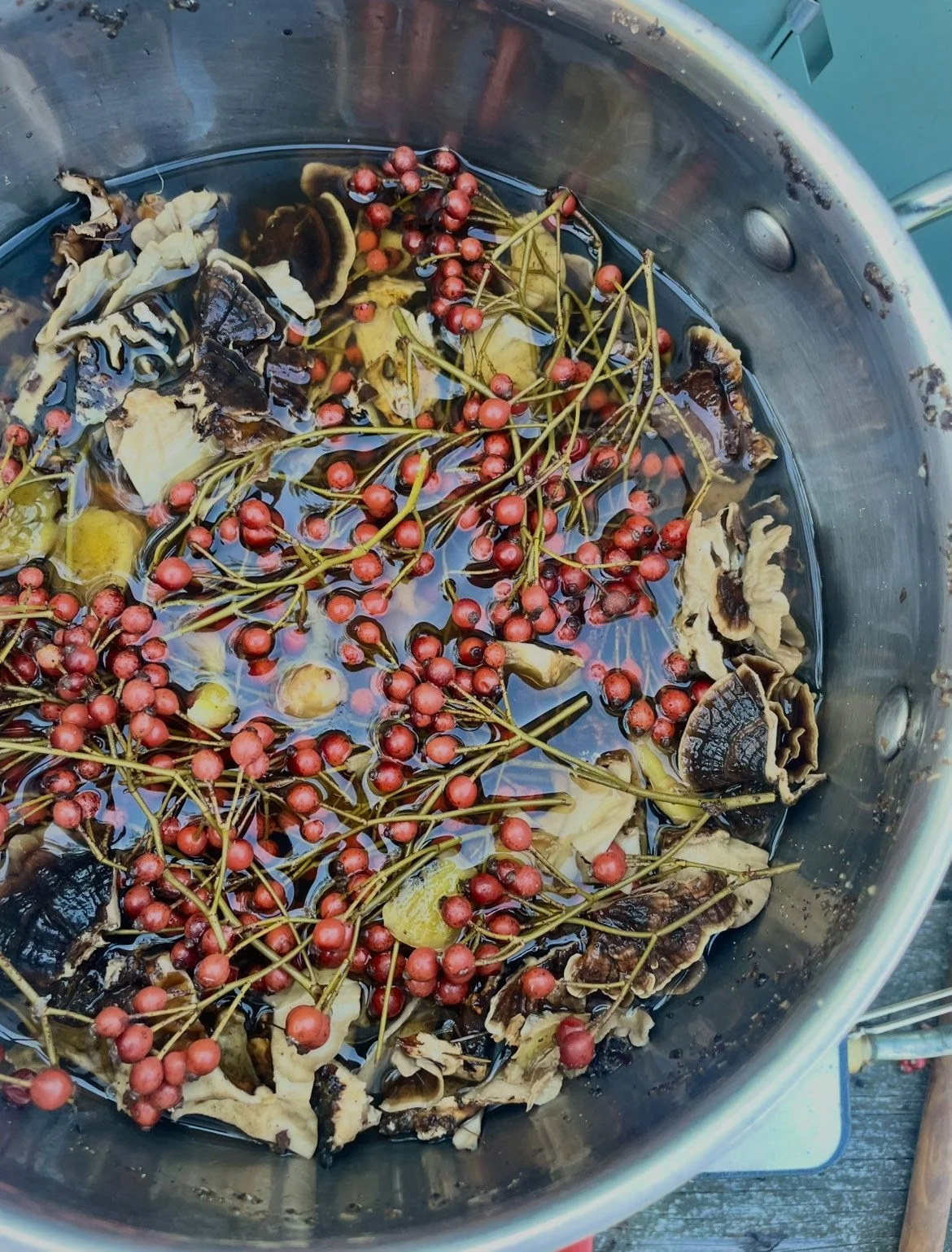
Making Turkey Tail & Rose Hip Syrup
immune-boosting teas. Combines well with mints, elderberry, lemon balm, and conifers like pine, fir, etc
cordials/elixirs or amaro
broths
wild soda and mead
to flavor kombucha
in soups and stews in place of tomatoes (there is a traditional Rose Hip Soup from Sweden called Nyponsoppa)
jelly
In many of the countries in the Andes region of South America it’s traditional to make a jelly with Rose Hips, which are called Rosa mosqueta. The name Rosa mosqueta is the common name used for at least three species which were introduced by the Spanish- Rosa mosqueta, R. rubiginosa (syn. R. eglanteria) and R. canina. The jelly is called Mermelada de rosa mosqueta.
Rose Hip Jelly can also be found all over Europe including the U.K., Germany, the Balkans, Mediterranean, Scandinavia, Russia and central Asia.
Use on toast, in confections, on cheeseboards, as a glaze for roasts….
syrup- put on oats, in tea, in cakes and sweets, drizzle on cake/pancakes/yogurt/ice cream, eat by the spoonful. And in Yellow Dock Iron Tonic Syrup
electuaries
chutney
herbal gummies
powder (make sure it’s from hulled Rose Hips) for a vitamin c-rich boost and to add the sour flavor to foods- cake and cookie batters, yogurt, smoothies, oats, porridge….
Flavor-wise, Rose Hips combine well in preparations with cinnamon, cardamom, ginger, mint, evergreens, bitter roots (dandelion, burdock), and medicinal mushrooms
Recipes
Rose Hip Vinegar
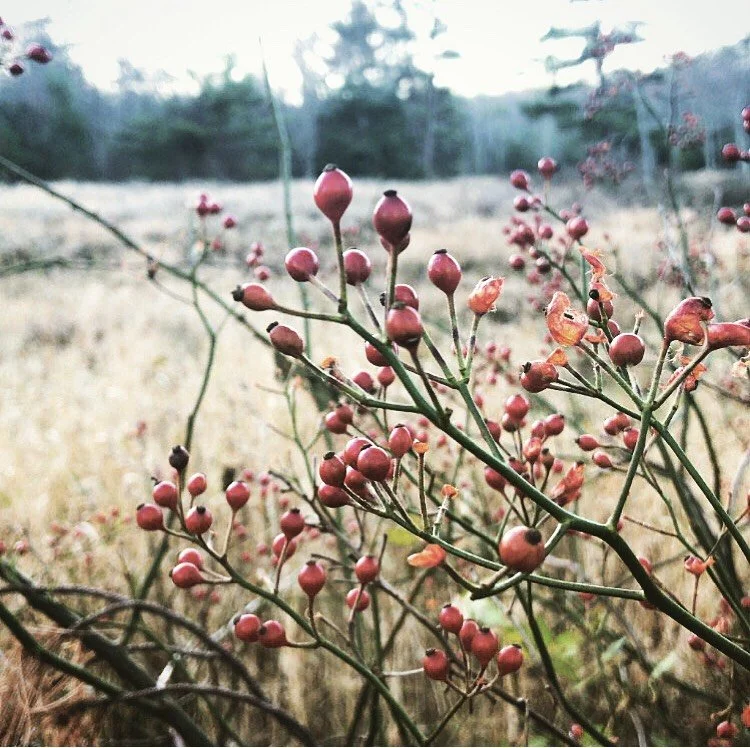
Rosa multiflora
Ingredients:
Rose hips (fresh or dried)
Apple Cider Vinegar
Directions:
With FRESH Rose Hips:
Fill the jar with whole or hulled hips and completely cover with the vinegar
Give it a little stir to remove air bubbles and top it off. It’s ok if some plant material is floating on the surface; it won’t mold as long as the Hips are saturated with the vinegar
Put a layer of wax paper between the lid and the jar or use a plastic lid, as the vinegar and even the fumes can corrode the metal lids
Let it steep, unrefrigerated, for 2 weeks then strain. Letting it steep for longer than a few weeks increases the chances of a vinegar mother growing, if using raw vinegar. If the vinegar is pasteurized, then there’s no risk of growing a mother.
Shelf-Life: There is no need to refrigerate, as vinegar is shelf-stable, but refrigerating it will increase its lifespan practically indefinitely. Vinegars are generally said to have a shelf-life of a year, but I usually use mine up well before that, although I have definitely seen them last longer unrefrigerated.
With DRIED Rose Hips:
Use a ratio of 1 part plant material to 4 parts vinegar menstruum, by volume. I.e. 1 cup dried Rose Hips: 4 c vinegar
Then follow the same basic directions as the fresh vinegar
Rose Hip Oxymel
Ingredients:
Apple Cider Vinegar
Raw Honey
Fresh Rose Hips
Instructions:
1. Put the rose hips in a glass jar
2. Cover the Hips about 75% of the way with apple cider vinegar and the remaining 25% of the way with raw honey. This is kitchen medicine so don’t fret if your percentages aren’t exact! (And it’s ok if you’re using crystallized raw honey that doesn’t dissolve right away- it will dissolve in the vinegar in a few days)
3. Put a layer of wax paper between the lid and the jar , shake well, and let macerate for 2-4 weeks, shaking daily if you can remember to.
4. Let it steep, unrefrigerated, for 2 weeks then strain. Letting it steep for longer than a few weeks increases the chances of a vinegar mother growing, if using raw vinegar. If the vinegar is pasteurized, then there’s no risk of growing a mother.
Shelf-Life: There is no need to refrigerate, as vinegar is shelf-stable, but refrigerating it will increase its lifespan practically indefinitely. Vinegars are generally said to have a shelf-life of a year, but I usually use mine up well before that, although I have definitely seen them last longer unrefrigerated.
Use:
Add to your favorite drinks, iced tea, drizzle on salads and fruits salads, add to seltzer, or just have a spoon full straight!
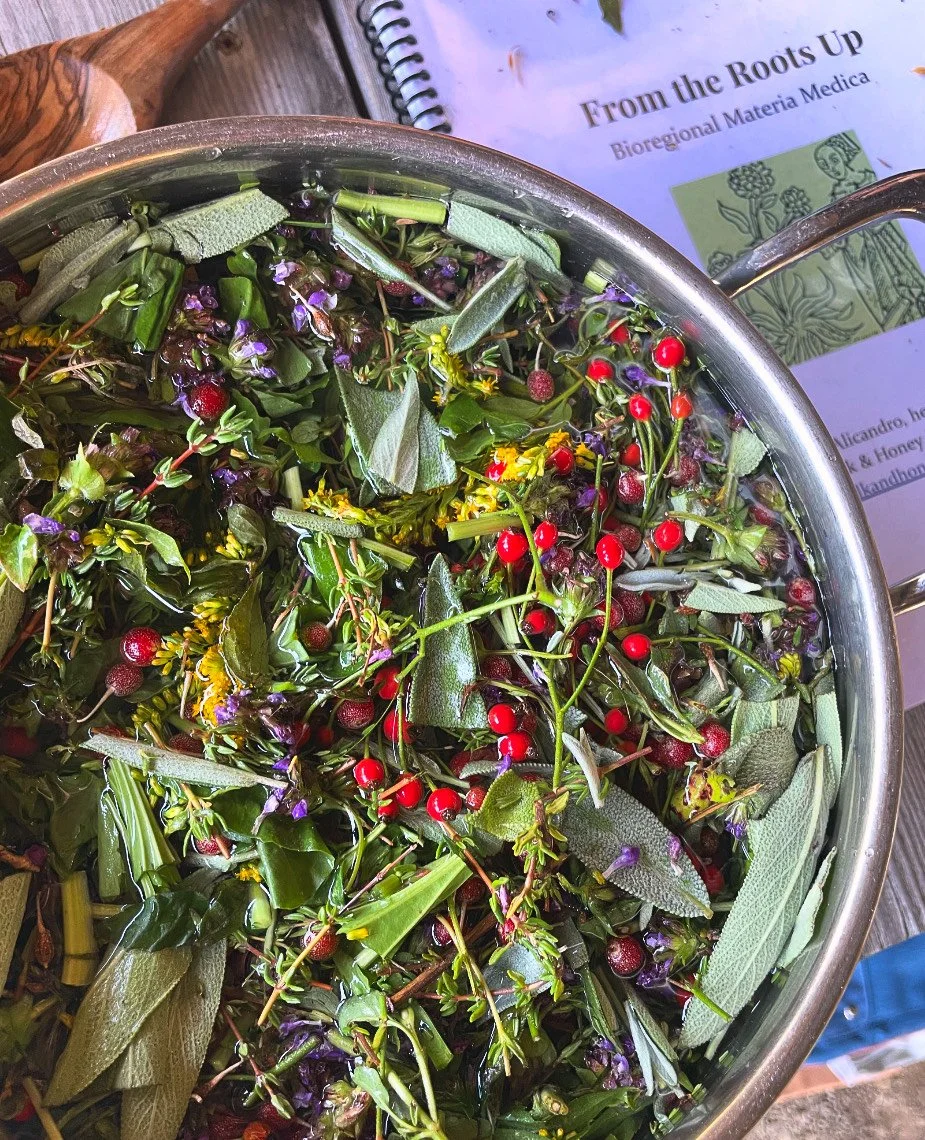
Fall Immune Syrup with Rose Hips
Rose Hip Syrup
Ingredients:
9 heaping tbsp fresh rose hips (hulled or whole) or 3 heaping tbsp dried rose hips
3 c water
¾ c raw honey or herbal honey
Apple Cider Vinegar, Tincture, or Alcohol of choice in 40-50% alcohol range (Brandy, etc)- optional
Directions:
1. Combine the rose hips (do not crush if whole) and water and bring to a low simmer
2. Simmer on low until the water is reduced by half (i.e. make a double decoction) to approx. 1.5 cups.
3. Strain and add to the honey
For basic ratios, you’re adding half as much honey as you have decoction. I like to combine the decoction and honey in a jar and cap and shake to mix but this can also be done gently on the stove top in a pan on low (do not heat over 110 degrees if using raw honey). It’s fine to use crystallized honey for this.
Shelf-life + Pro-tips:
Syrups need to be kept in the fridge and typically have a shelf-life of 8-12 weeks before they go bad, BUT if they are made with anti-microbial and/or vitamin C-rich herbs they tend to last longer.
Another way to extend the shelf-life of herbal syrups is by adding ¼ c of a tincture, apple cider vinegar, or alcohol of choice in the 40-50% alcohol range, such as Brandy, for every cup of finished syrup you have. For instance, if you have 1 cup of this syrup you would add ¼ of tincture of choice, alcohol, or apple cider vinegar.
This is optional and you will still need to refrigerate your syrup, but it will greatly extend the life of your syrup and is a great place to get more medicinal action in if you’re using a tincture. Another place to boost the medicinal benefit is by adding an herbal honey rather than just plain raw honey.
Use:
1 tbsp is a medicinal dose
Reishi & Rose Hip Deep Immune Syrup
Ingredients:
Reishi Mushroom (Ganoderma lucidum, G. tsugae) 1 part (or medicinal mushroom of choice)
Astragalus (Astragalus membranaceous) 1 pt
Rose Hips, whole or hulled 1 pt
Ginger ¼ pt
Honey (ideally raw)
Water
Apple Cider Vinegar, Brandy, or similar alcohol of 40-50% alcohol
Directions:
Make a decoction of the herbs by combining them with water at a ratio of 1 heaping tbsp dried herbs to 1 cup water.
Make 1 part any unit you’d like. For instance, it could be 1 tbsp Rose Hips, 1 tbsp Reishi, 1 tbsp Astragalus, ¼ tbsp Ginger and 3.25 c water
Simmer the herbs and water on medium-low until the water reduces in volume by about half.
Strain, and add equal amts of honey to the liquid you have left. For instance, if you have 1 cup of decoction, add 1 cup of honey.
You may add apple cider vinegar or brandy, at a ratio of 1/4th cup for every cup of finished syrup if desired, which will help extend the shelf-life. You can also use a tincture of any of these ingredients instead of the brandy/alcohol
Shelf-life: Must be refrigerated. Lasts about 2 weeks without the addition of the apple cider vinegar/alcohol and months with it.
Use:
This syrup builds-up and strengthens immunity at the bone marrow level. Helps prevent colds and flus and strengthens low immunity. For the person who catches everything that goes around. Enhances over-all health and may be used as a daily tonic. Stop using it while acutely sick with a cold, flu, etc. Take 1-2 tbsp/day on its own mixed in warm water, in bubbly water, in and on foods, etc
Rose Hip Electuary

Rosa multiflora
Ingredients:
Powdered Rose Hips (make sure they’re hulled!)
Raw Honey
Directions:
1. Put your powdered herbs in a bowl
2. Stir in the honey little by little until you get desired consistency. You’re generlaly going for a paste or dough-like consistency
3. It’s immediately ready to use
It’s vital that the herbs are powdered well for these to be palatable- a coffee or spice grinder works well for this.
Other nice additions to this would be any of the chai spices or powdered everygreens.
Use: 1 tbsp is a medicinal dose
Shelf-life: Keeps indefinitely, unrefrigerated
No-Cook Rose Hip Jam
This is a wonderful way to enjoy rose hips that I learned from a student- Soak dried, hulled Rose Hips overnight in some apple juice. In the morning they will have re-hydrated and softened and you'll have a no-cook '"rose hip jam" that you can eat by the spoonful or even put on your toast- what a wonderful way to get your daily dose of vitamin C!
Nyponsoppa: Swedish Rose Hip Soup
A traditional soup in Sweden, often served as a dessert with whipped cream! This is a good recipe, however it calls for mushing the Rose Hips and then straining them through a very fine mesh strainer. If you choose to mush them up, definitely don’t skip that straining step and I’d advise a few layers of cheese cloth as well for good measure, to make sure none of the fine hairs get in! You can also choose to use honey in place of the sugar.
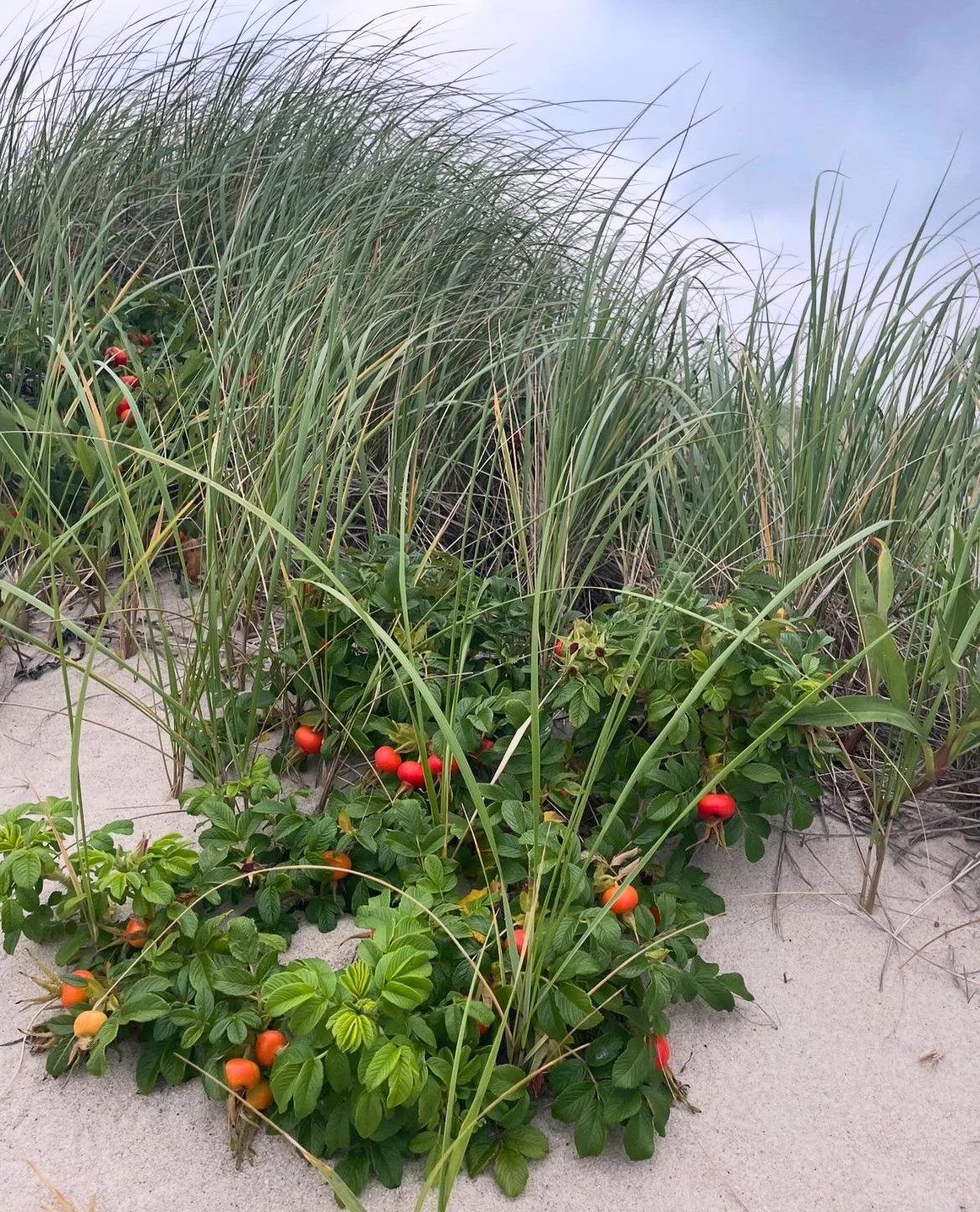
Beach Rose hips (Rosa rugosa)
Rose Hip Jelly
There are numerous recipes out there, as this is a traditional preparation in a huge amount of the globe
Here’s a recipe I like for fresh rose hips jelly, which can be canned.
Rose Hip Gummies
Ingredients:
3 cups unsweetened juice (cherry, grape, cranberry or pomegranate are all nice choices)
1 cup dried rose hips, hulled or whole
½ unflavored, grass-fed gelatin powder (Great Lakes and Vital Proteins brand are both great choices)
¼ cup raw honey (optional)
Directions:
Simmer the juice and the herbs, covered, on low heat for about 20-30 minutes
Strain into another pan and let cool until it’s still warm but not hot
Mix in the honey (if using) and the gelatin and mix rapidly until the gelatin dissolves, gently warming if it’s gotten too cold for the gelatin and honey to dissolve, but not bringing to a boil
Line a baking tray or shallow baking dish with parchment paper. Pour the mixture into a shallow baking dish or tray. You can also use silicone gummy molds for cute shapes!
Put into fridge and allow to cool, where it will solidify into a jello-like consistency.
Cut into 1 inch sized cubes or remove from the molds
Shelf-life: Store in fridge for up to 2 weeks. Freeze them if you make a super large batch!
Use: Medicinal dose is 3 one inch-sized gummies/day
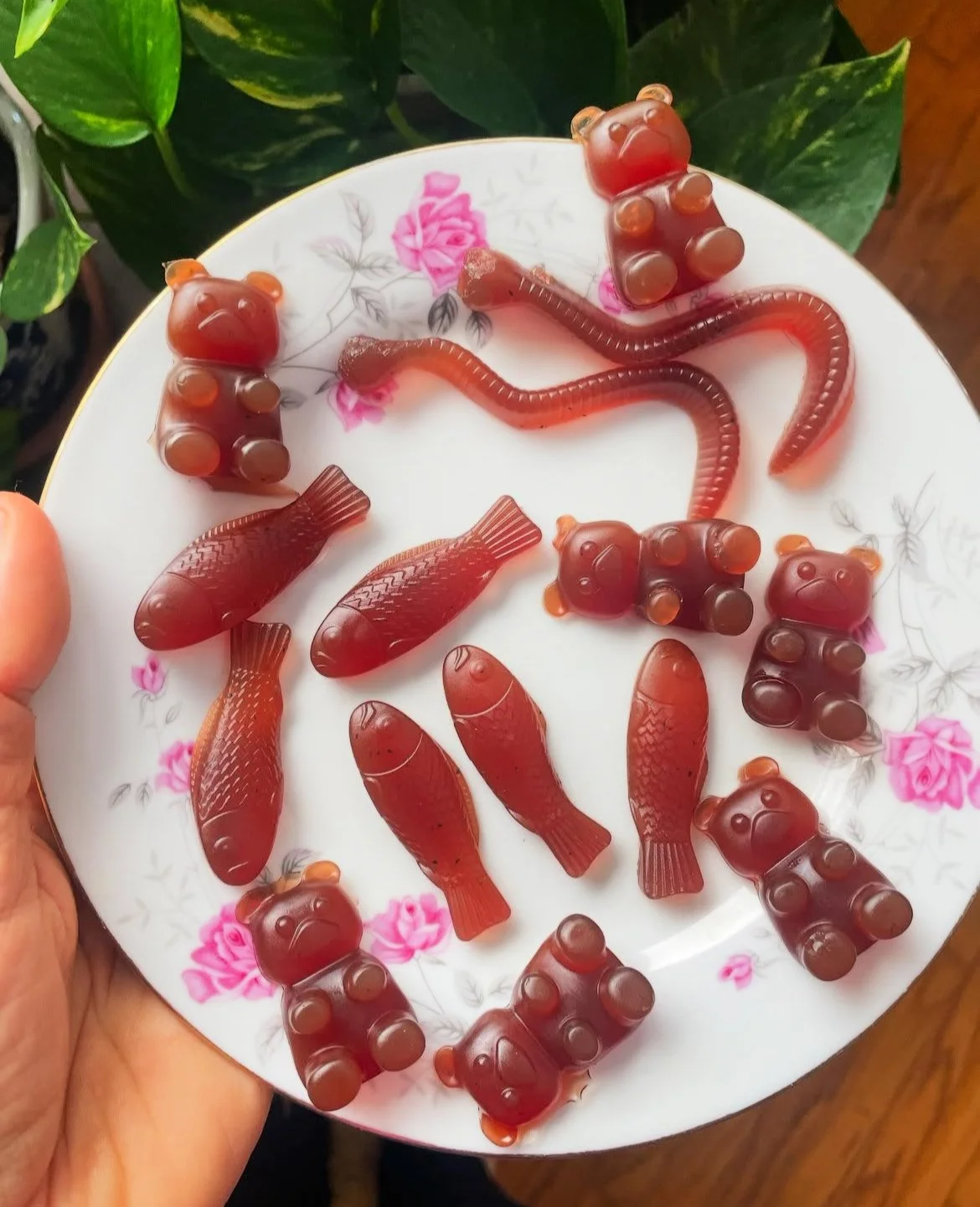
Vitamin C Immune Gummies
Vitamin C Immune Gummies
Ingredients:
3 cups unsweetened juice
1/2 c dried elderberries
¼ c dried rose hips
¼ c dried astragalus
1/8th c (2 tbsp) dried ginger
1/2 c unflavored, grass-fed gelatin pwd
¼ c raw honey
Directions: Follow the instructions above
Immune Boost Decoction
Ingredients:
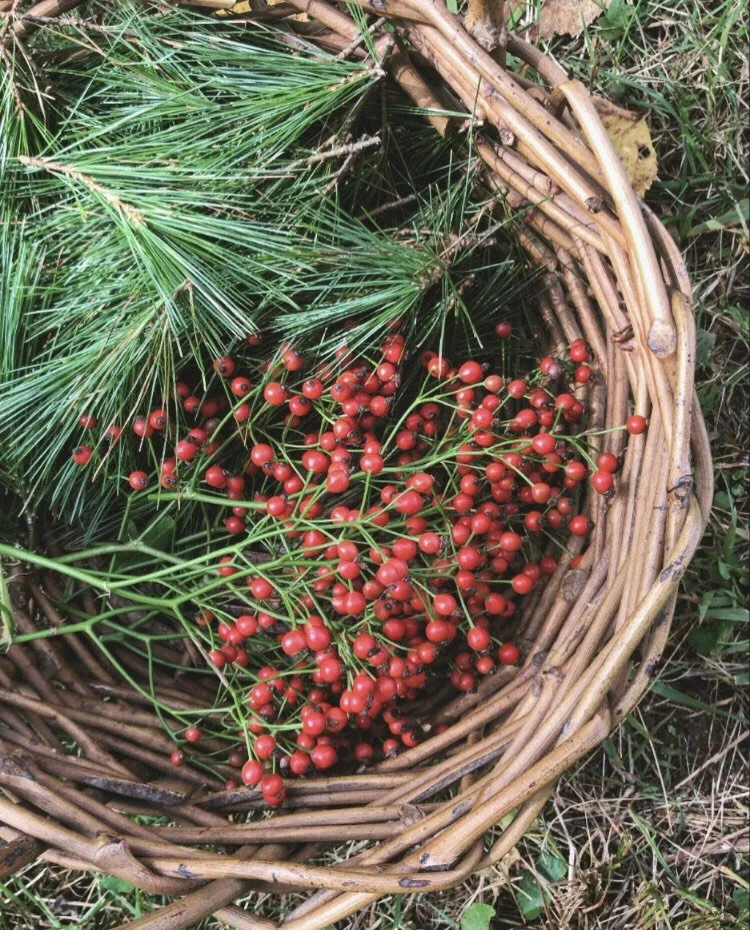
Rose Hips (Rosa multiflora) & White Pine (Pinus strobus)
Rose Hips 1 part
Astragalus root 1 part
Medicinal Mushroom 1 part- good choices are Reishi, Maitake/Hen of the Woods, Shiitake, or Birch Polypore (Fomitopsis betulina)
Ginger ¼ part
Raw Honey
Directions:
Make 1 part any amount of herb you’d like (i.e. 1 tbsp, ½ c, 1 cup, etc) and combine in the proportions above. For instance if you decide to make 1 part= 1 cup, you’d use 1 cup each of Rose Hips, Astragalus, and Mushroom each and ¼ c Ginger.
Add 1 heaping tbsp of the herb mix: 1 c H20 to a pan
Simmer on medium-low, uncovered, until the water volume is reduced by half
Strain
Shelf-life: Will keep 1-2 days refrigerated. Have at least 2 cups throughout the day, hot, if you feel you’re coming down with something. Leave out the Astragalus if you have a fever and do not take when you’re acutely fevering if it has Astragalus
Use:
Have at least ½ c/day if feeling like you’re coming down with something. Leave the Astragalus out if you have a fever and do not take during an active fever if it contains Astrgalus
Interested in learning more about our bioregionally abundant medicinal plants? Our 9 month From the Roots Up herbal apprenticeship in bioregional herbalism is currently enrolling! This experience introduces students to the rich world of folk herbalism, botany, herbal ecology, medicine-making and more
2027 classes are currently enrolling
Learn More Here!
References & Resources

Beach Rose (Rosa rugosa)
Rosa canina Extracts Have Antiproliferative and Antioxidant Effects on Caco-2 Human Colon Cancer
Plos One Journal
By Sandra Jiménez, Sonia Gascón, Asunción Luquin, Mariano Laguna, Carmen Ancin-Azpilicueta, and María Jesús Rodríguez-YoldiRose Hips, a Valuable Source of Antioxidants to Improve Gingerbread Characteristics
Molecules Journal
By Aliona Ghendov-Mosanu, Elena Cristea, Antoanela Patras, Rodica Sturza, and Marius NiculauaTherapeutic Applications of Rose Hips from Different Rosa Species
International Journal of Molecular Science
By Inés Mármol, Cristina Sánchez-de-Diego, Nerea Jiménez-Moreno, Carmen Ancín-Azpilicueta, and María Jesús Rodríguez-YoldiRosehip - an evidence based herbal medicine for inflammation and arthritis
Aust Family Physician, 2012
By Marc CohenNutritional Content of Rose Hips
USDA Data